Skip to content
Routiness
Individual

Individual dynamics

Twenty-seven guided exercises you do alone, from a link, at your own pace. Filter by what you want to work on.

Filter by area

27 dynamics

Mirror
Individual

Mirror

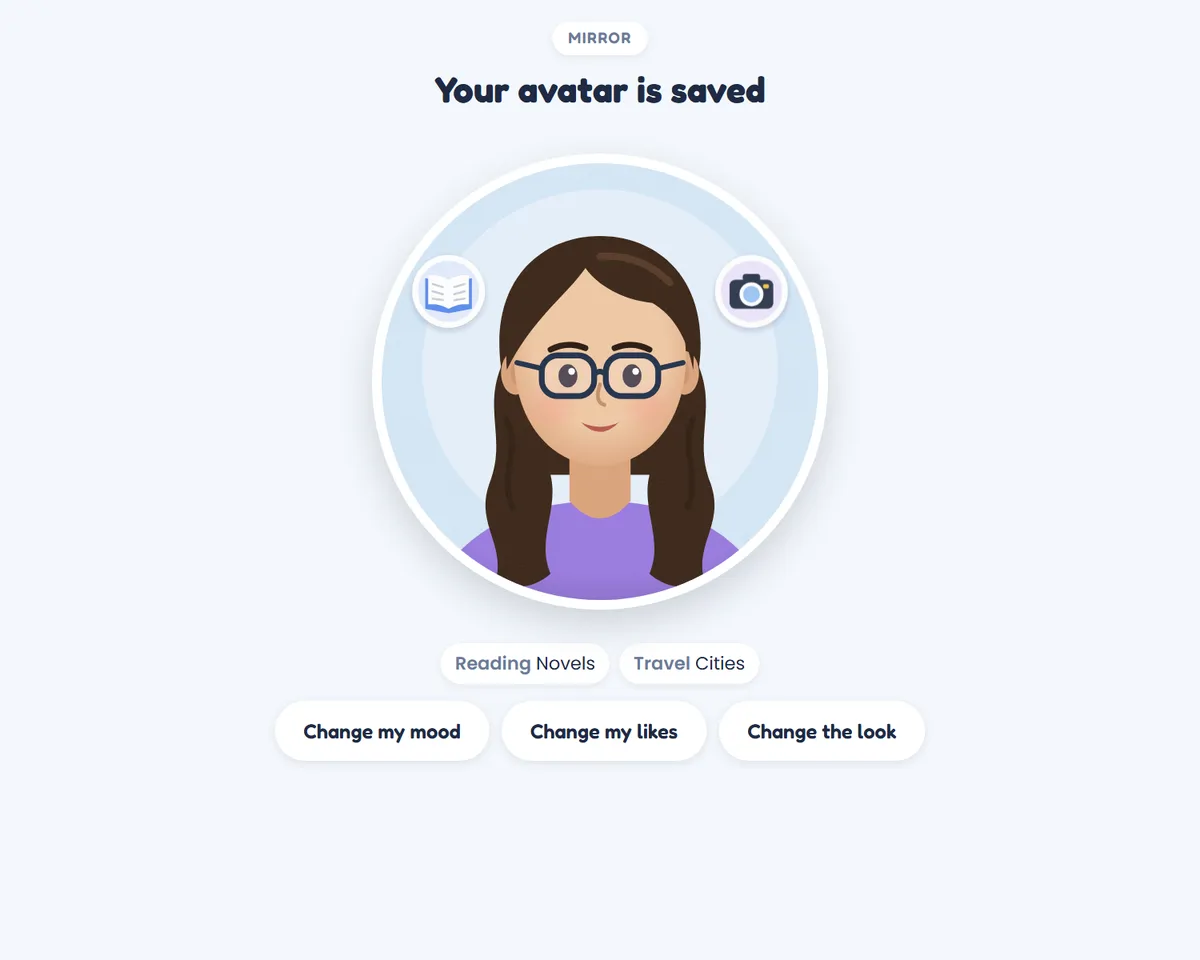
You build a character that represents you by answering questions about how you look, how you feel and what you like. That avatar then goes with you into your file and the other dynamics, and opens the conversation about how you see yourself.
  • Identity and self-knowledge
Personality test
Individual

Personality test

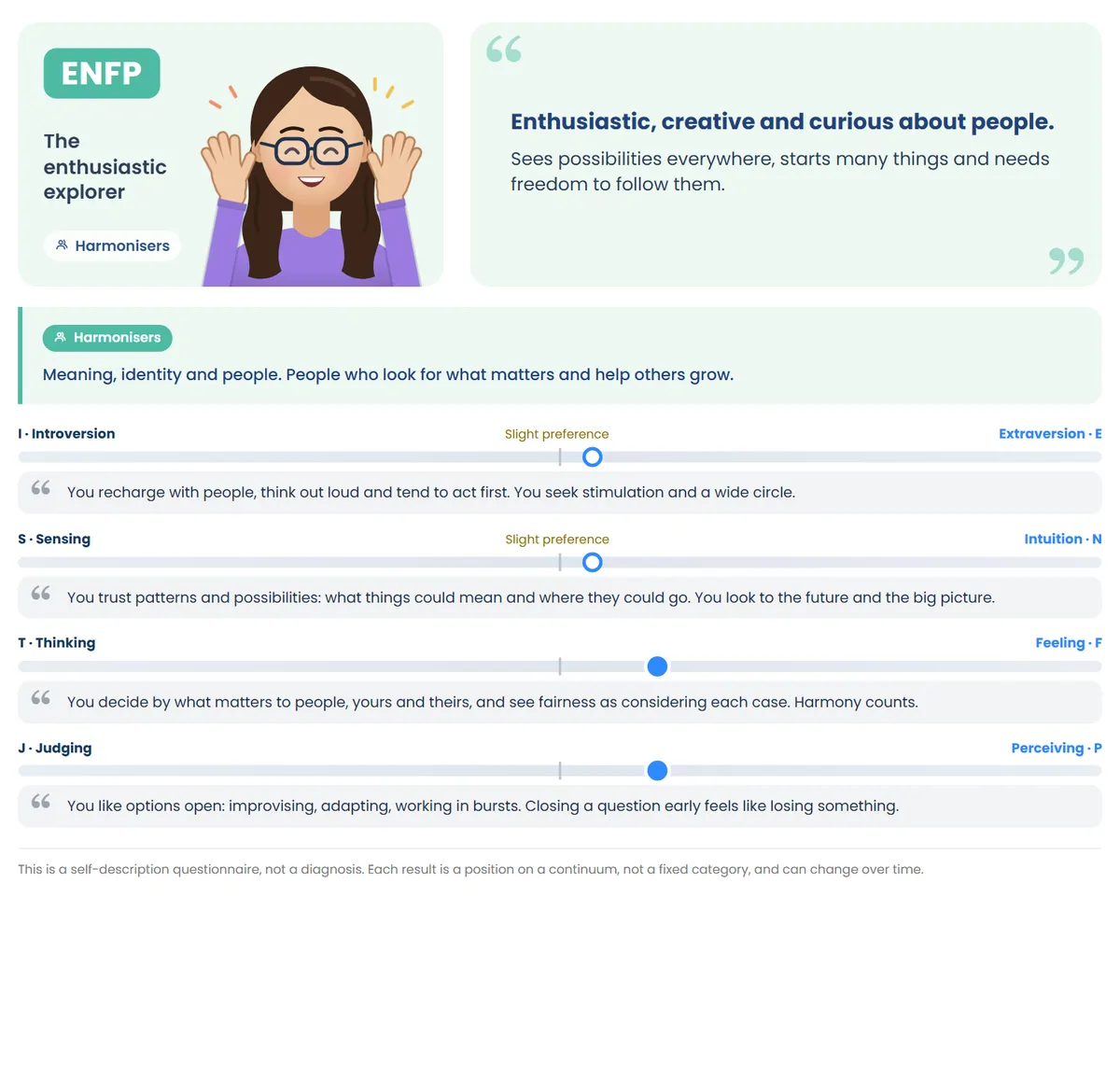
A 16-type or Big Five questionnaire you answer alone, scored when you finish. The result shows your profile, the detail of each trait and your own character acting out the type.

  • Identity and self-knowledge
Self-assessment
Individual

Self-assessment

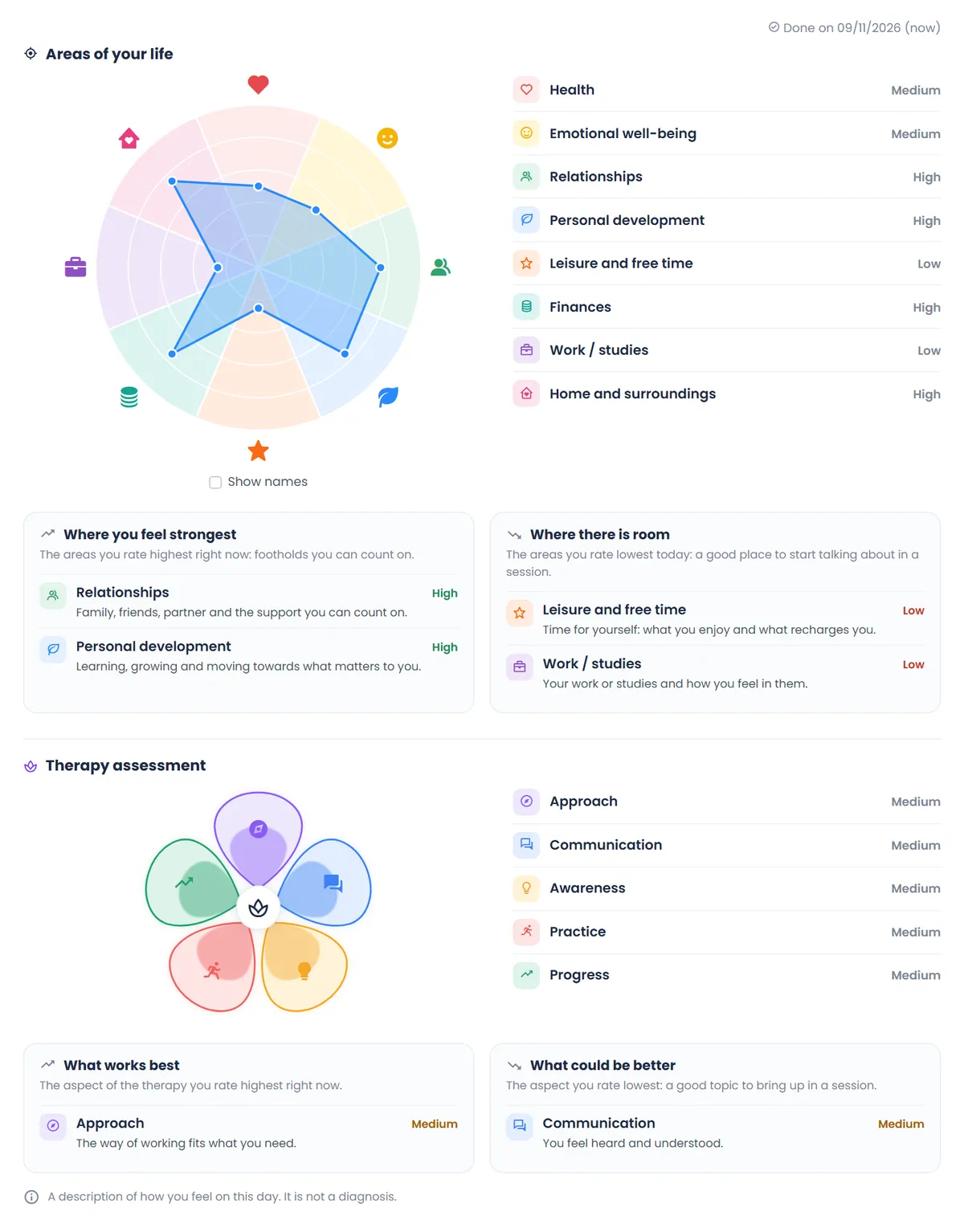
Eight areas of your life, such as health, relationships, work or home, rated with simple statements. Your summary shows the level of each area, the wheel, how it changes over time and how the work is going, with no numbers.

  • Follow-up
Correspondence
Individual

Correspondence

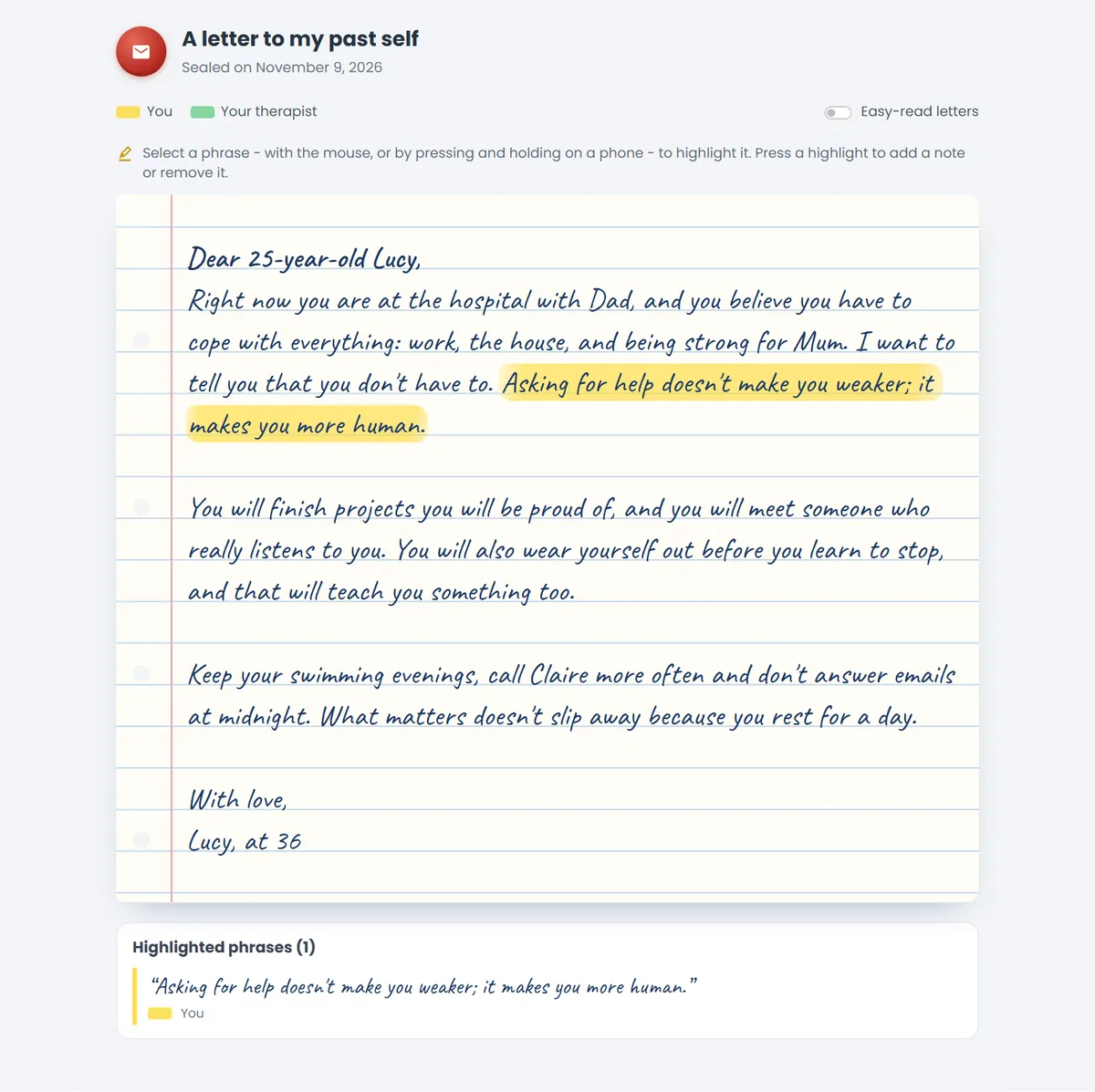
A letter written on a notebook page: to your past or future self, to a relative, to a friend or to whoever you choose. Once sealed, you and your professional underline the sentences that stand out and can add a note.

  • Personal history and life stages
  • Interpersonal conflicts
  • Bonds and emotional needs
  • Grief and loss
  • Perspective and empathy
Attention budget
Individual

Attention budget

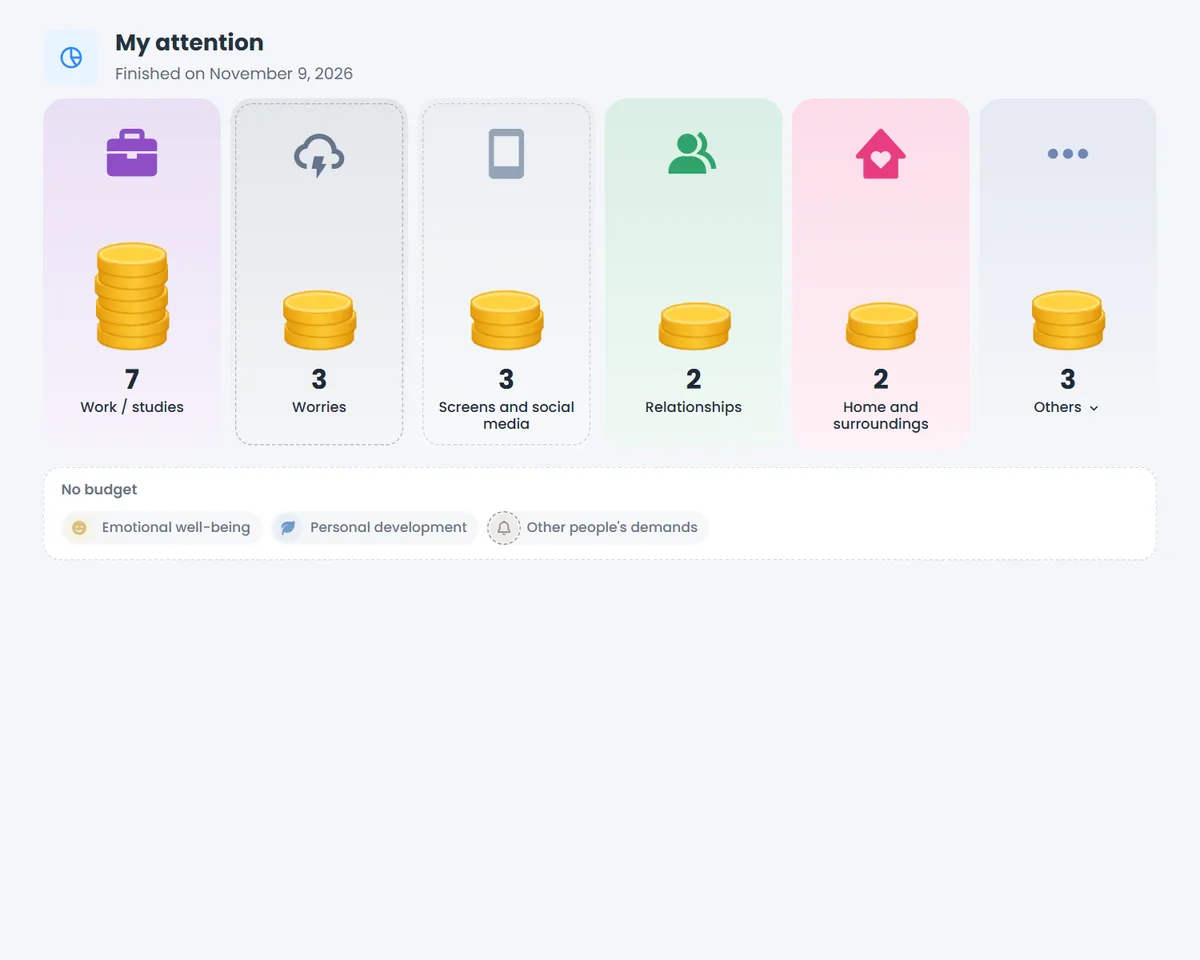
You share out 20 points among the areas of your life according to where your attention has really gone. The result, in piles of coins, shows what takes the biggest share and what was left with no budget.

  • Values and priorities
  • Stress and overload
The scales
Individual

The scales

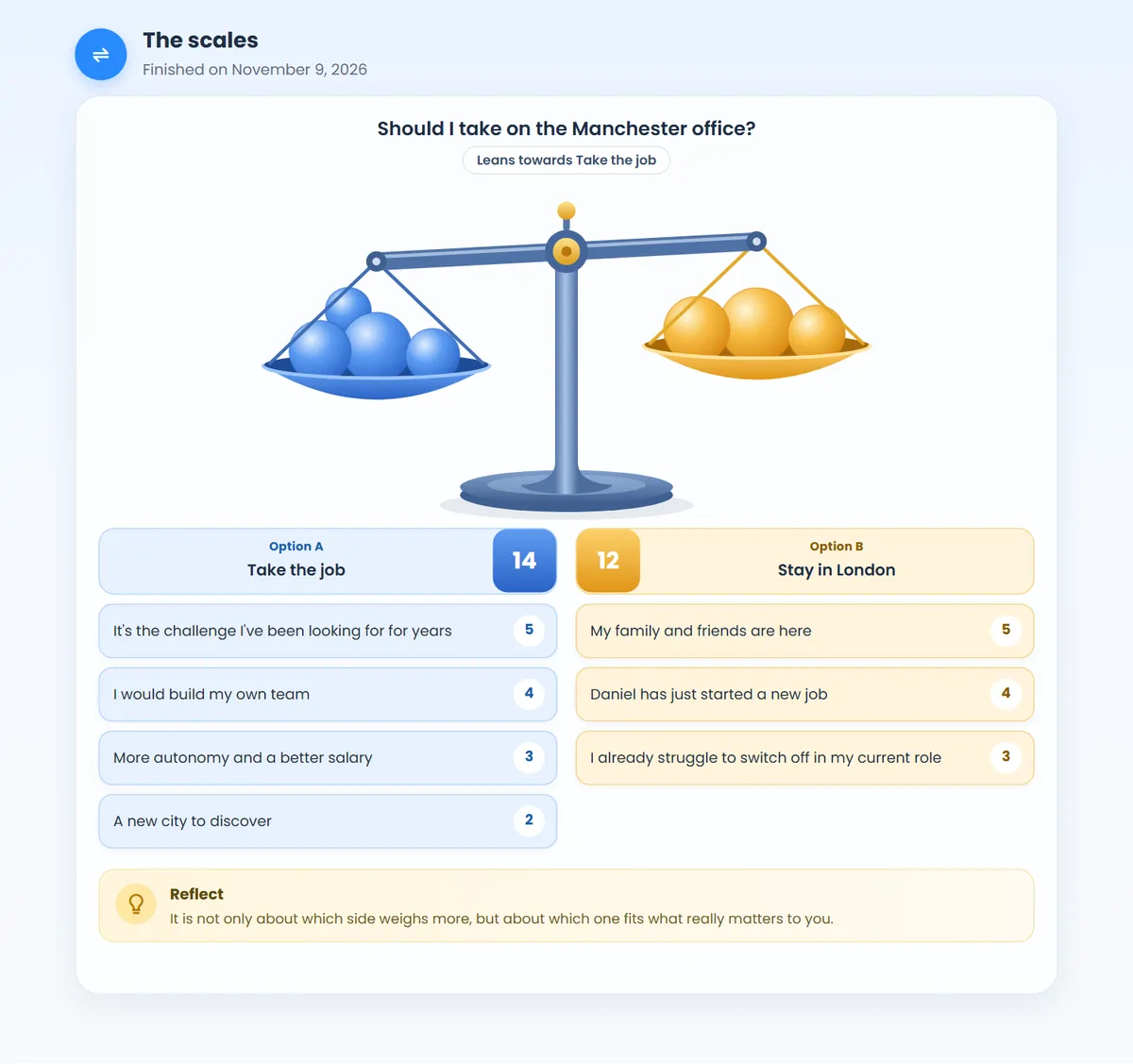
A decision between two options: you write the reasons on each side and give each one a weight from 1 to 5. The scales tip towards the heavier side and help you see what really matters.

  • Decision making
The battery
Individual

The battery

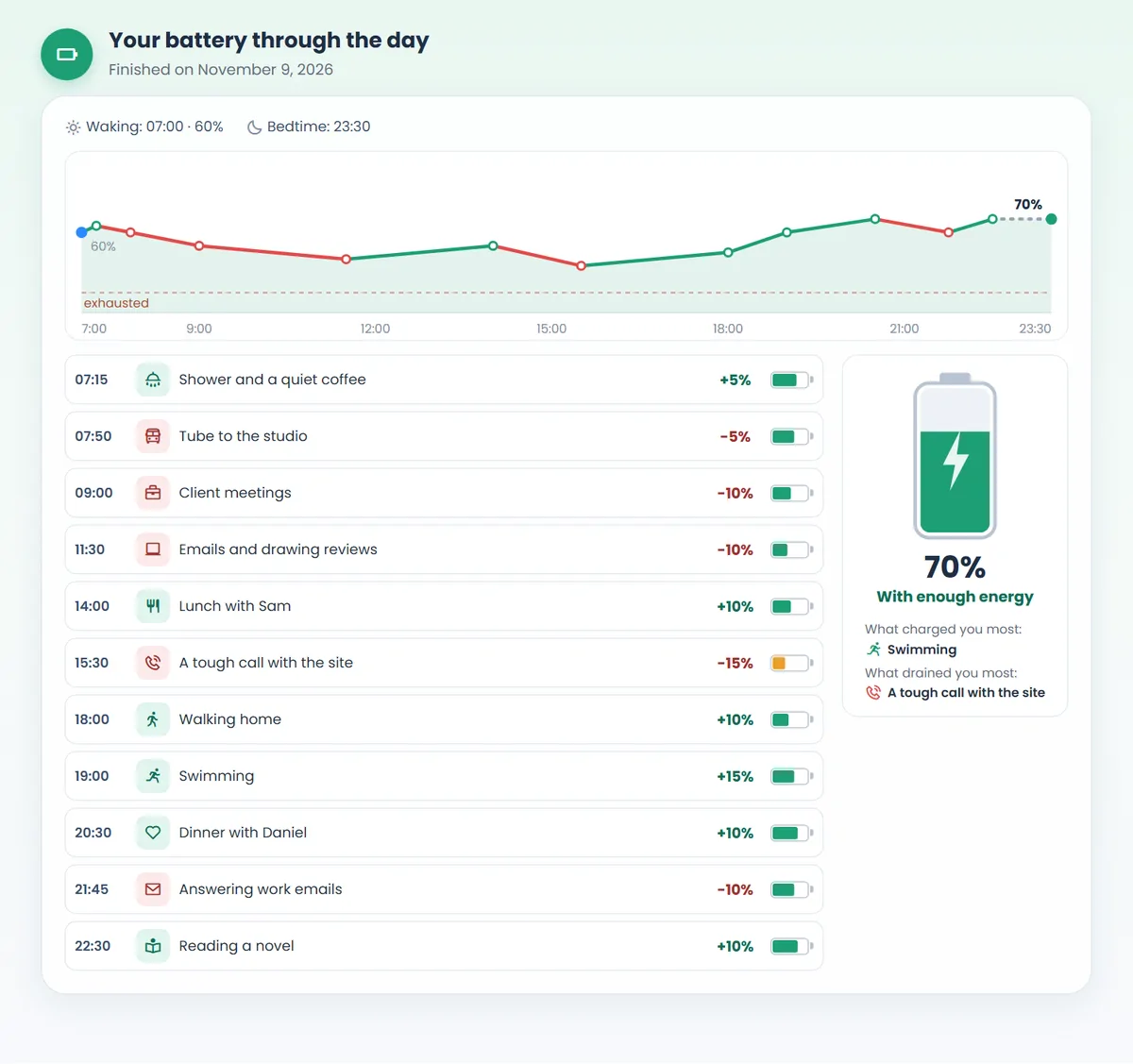
One day from the moment you get up to the moment you go to bed: how much energy you start with and how much each activity charges or drains. The curve and the final battery show whether you end the day with energy to spare or worn out.

  • Motivation and activation
  • Stress and overload
  • Self-care and personal balance
Lifeline
Individual

Lifeline

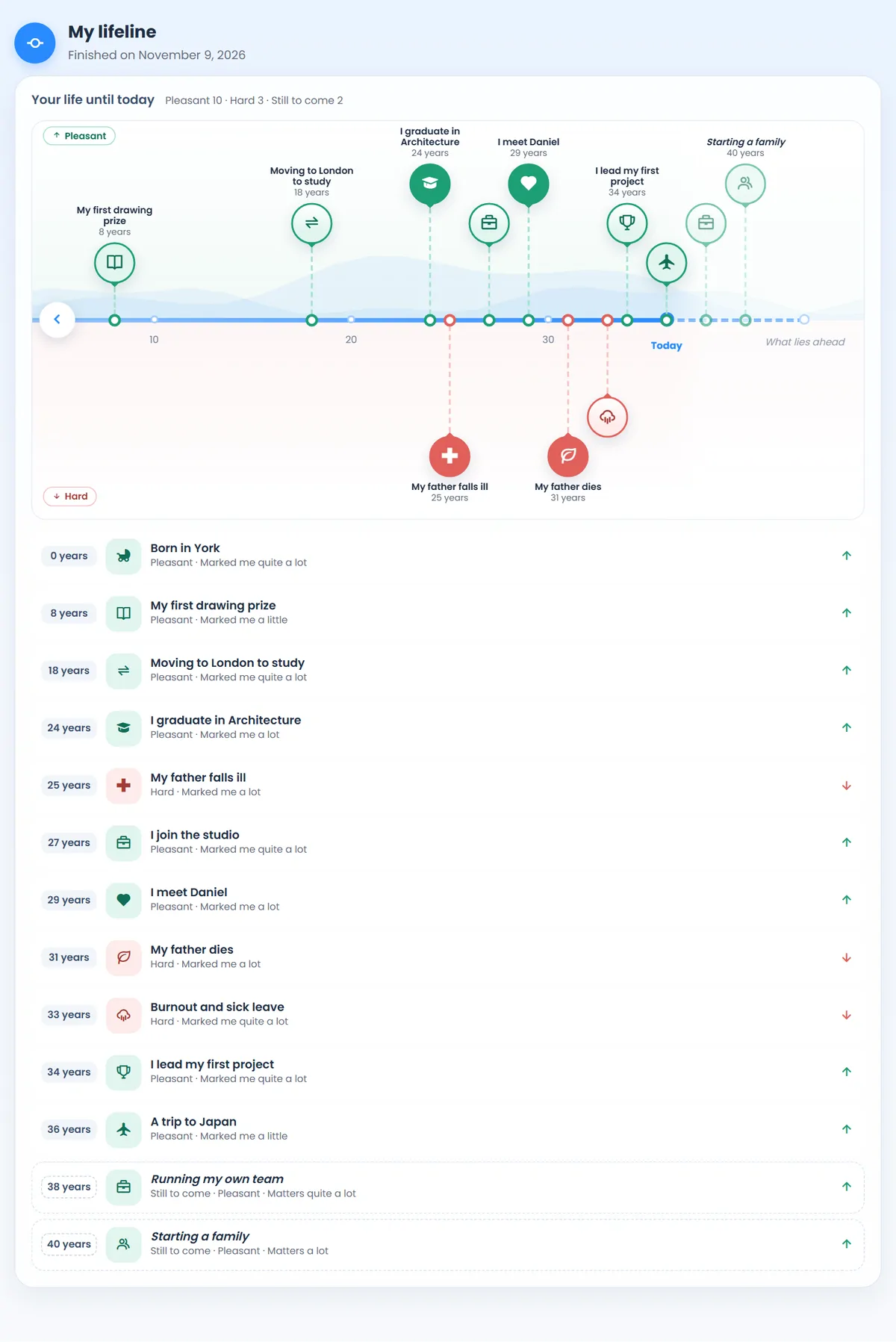
The moments that marked your life, placed on a line from your birth to today: the pleasant ones above, the hard ones below, further out the more they marked you. After today, what you see coming.

  • Personal history and life stages
  • Grief and loss
Three scenarios
Individual

Three scenarios

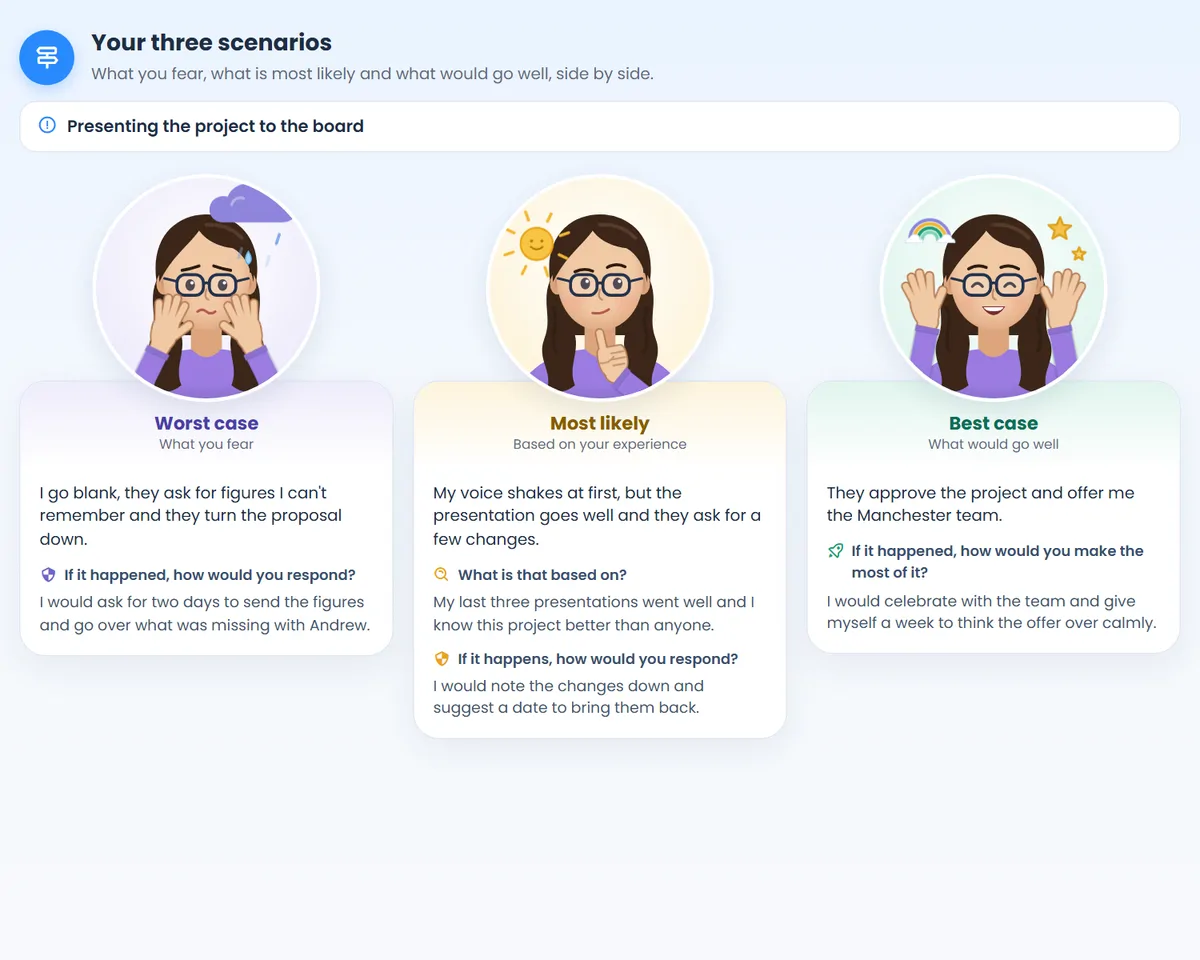
A situation that worries you, seen three ways: what you fear, what is most likely and something favourable, with how you would respond to each. Your character acts out each scenario.

  • Exploring a problem
  • Frustration tolerance
  • Adapting to change
Relationship map
Individual

Relationship map

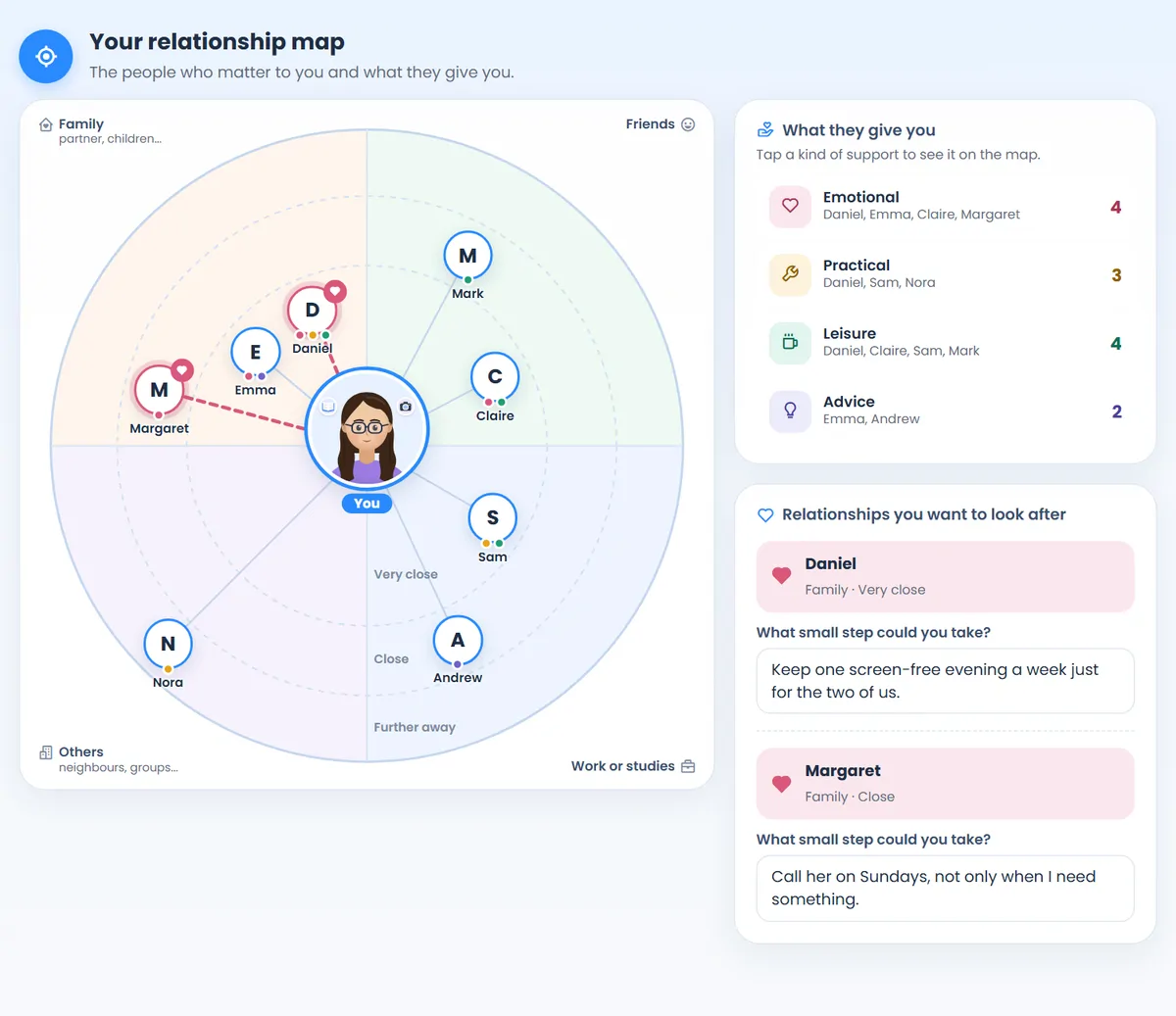
The important people in your life placed around you, closer or further away, in the part of your life they belong to and with what each one gives you. You end by choosing the relationships you want to look after.

  • Bonds and emotional needs
  • Perspective and empathy
Boundary map
Individual

Boundary map

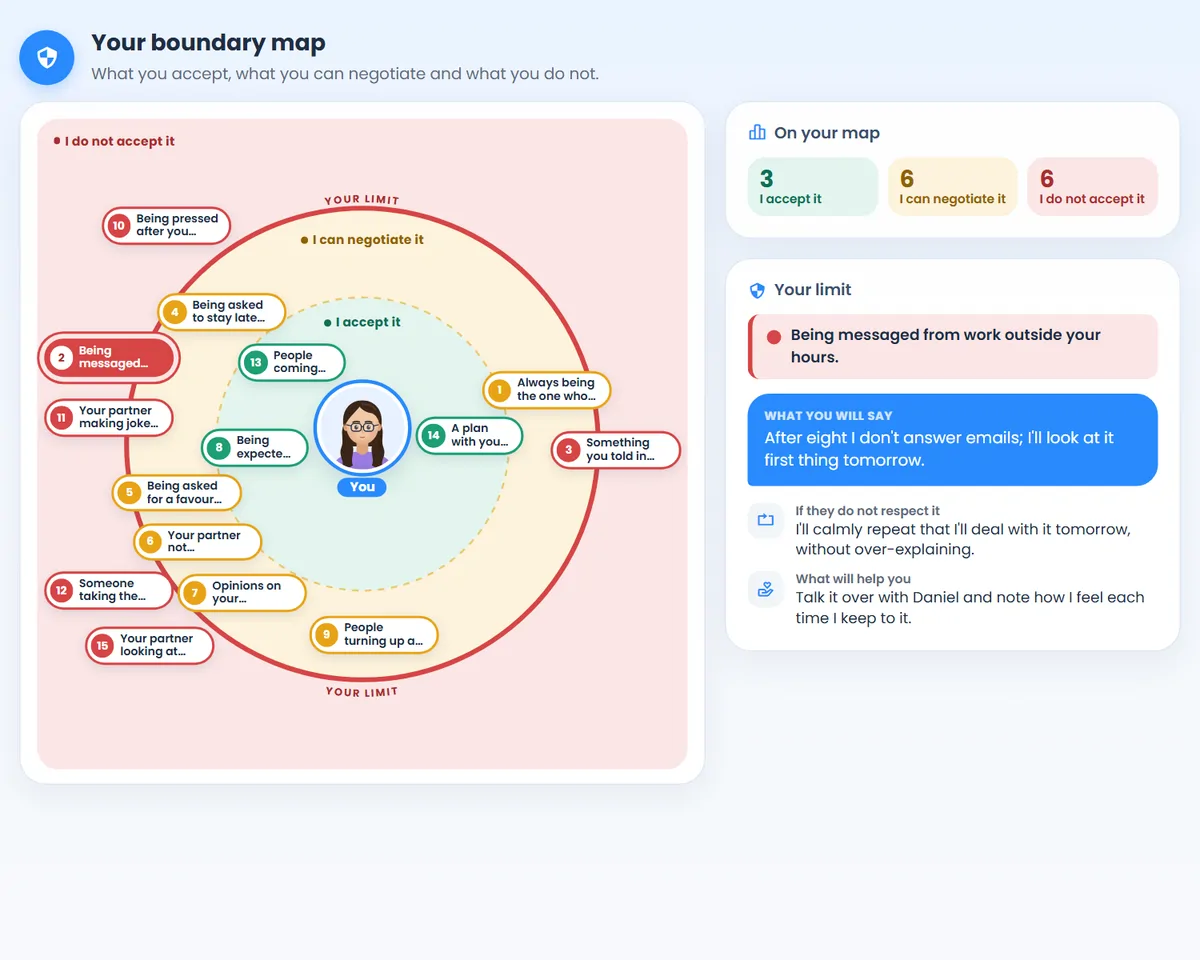
Fifteen everyday situations run through a traffic light: I accept it, I can negotiate it, I do not accept it. The resulting map is used to prepare one concrete boundary: what you will say and how you will hold it.

  • Assertiveness and boundaries
Before and now
Individual

Before and now

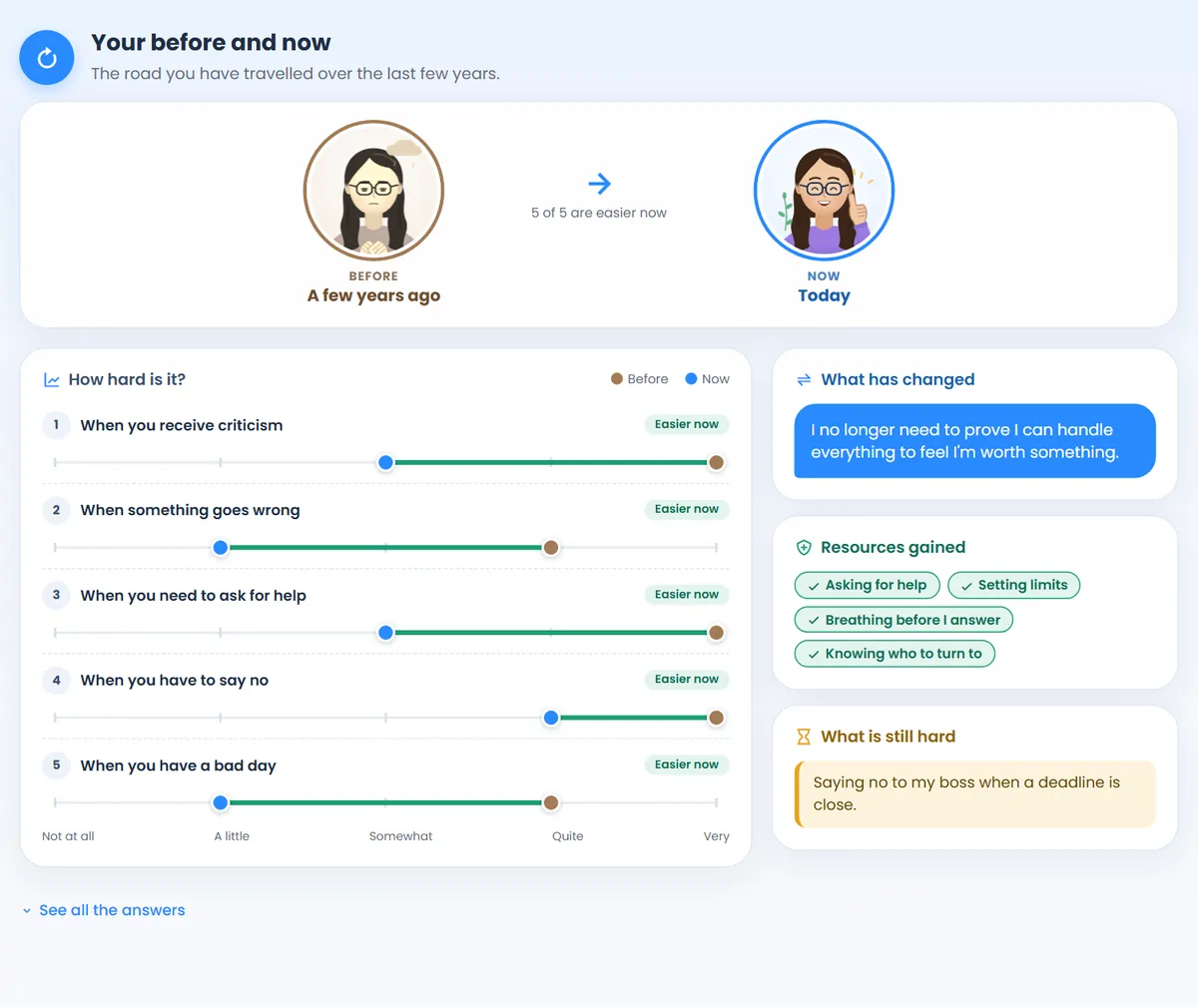
The same situations answered thinking of a few years ago and of today: what you did and how hard it was. The comparison shows what has changed, the resources you have gained and what is still hard.

  • Self-esteem and strengths
  • Follow-up
  • Adapting to change
My inner dialogue
Individual

My inner dialogue

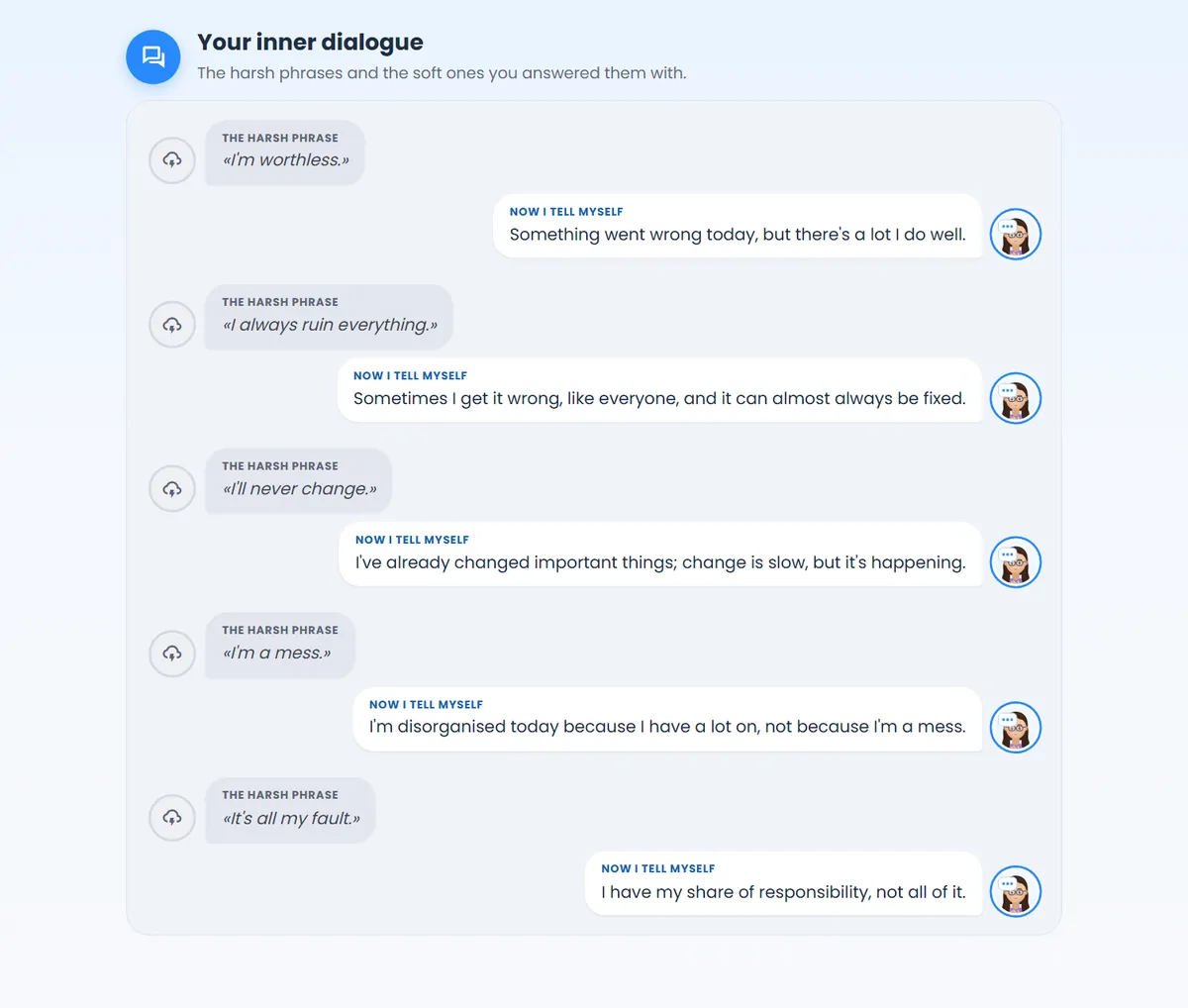
Harsh things we sometimes tell ourselves, laid out as a conversation. You answer each one with a kinder sentence: realistic, respectful and one you can believe.

  • Managing emotions
  • Self-esteem and strengths
  • Frustration tolerance
Gratitude journal
Individual

Gratitude journal

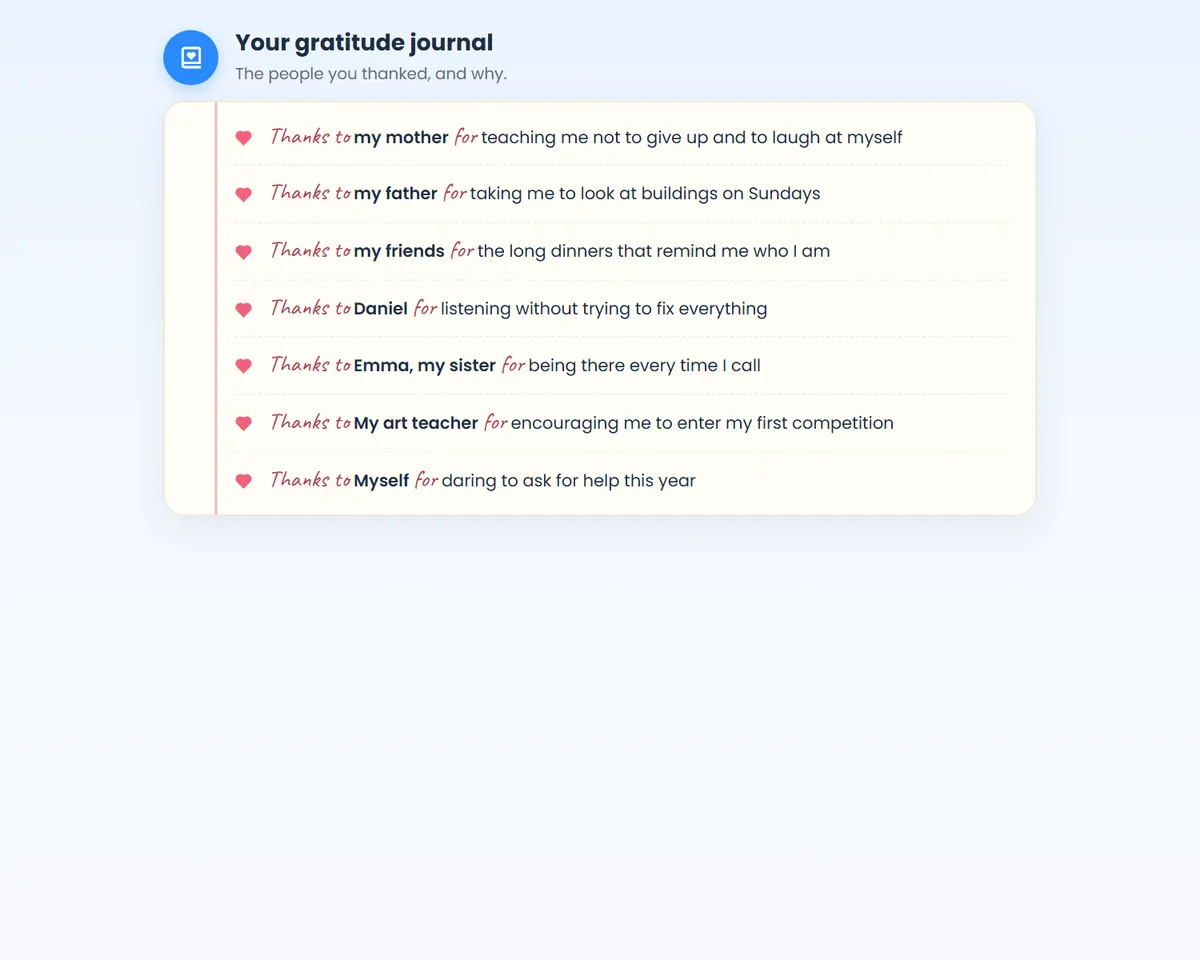
"Thanks to ___ for ___": you thank the people of your whole life, one line each, on a notebook page.

  • Self-esteem and strengths
  • Bonds and emotional needs
  • Grief and loss
Routine design
Individual

Routine design

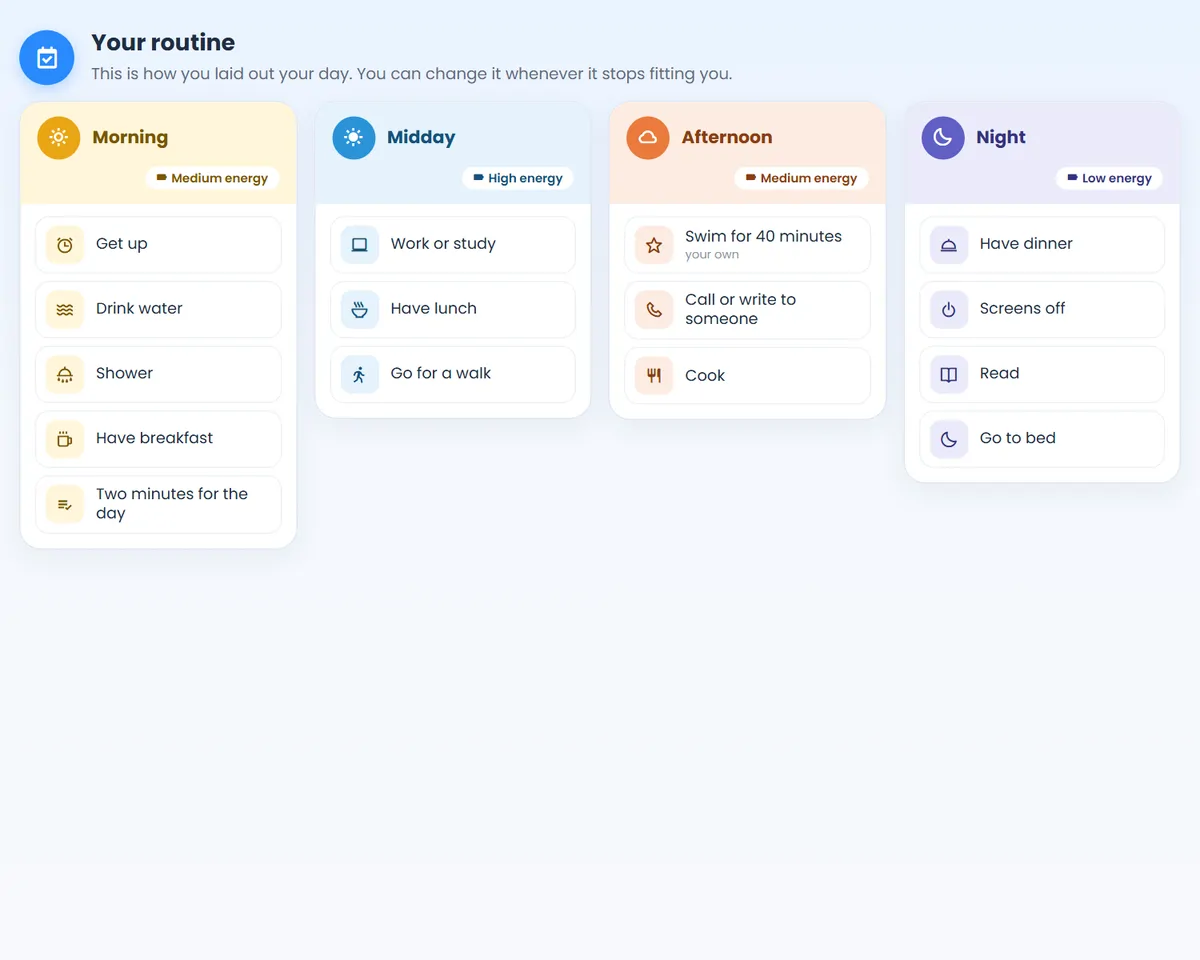
Morning, midday, afternoon and night: the energy of each moment and the basic actions you want in it, chosen from a catalogue of ideas. A realistic routine, without turning it into a list of duties.

  • Self-care and personal balance
  • Building habits
My next chapter
Individual

My next chapter

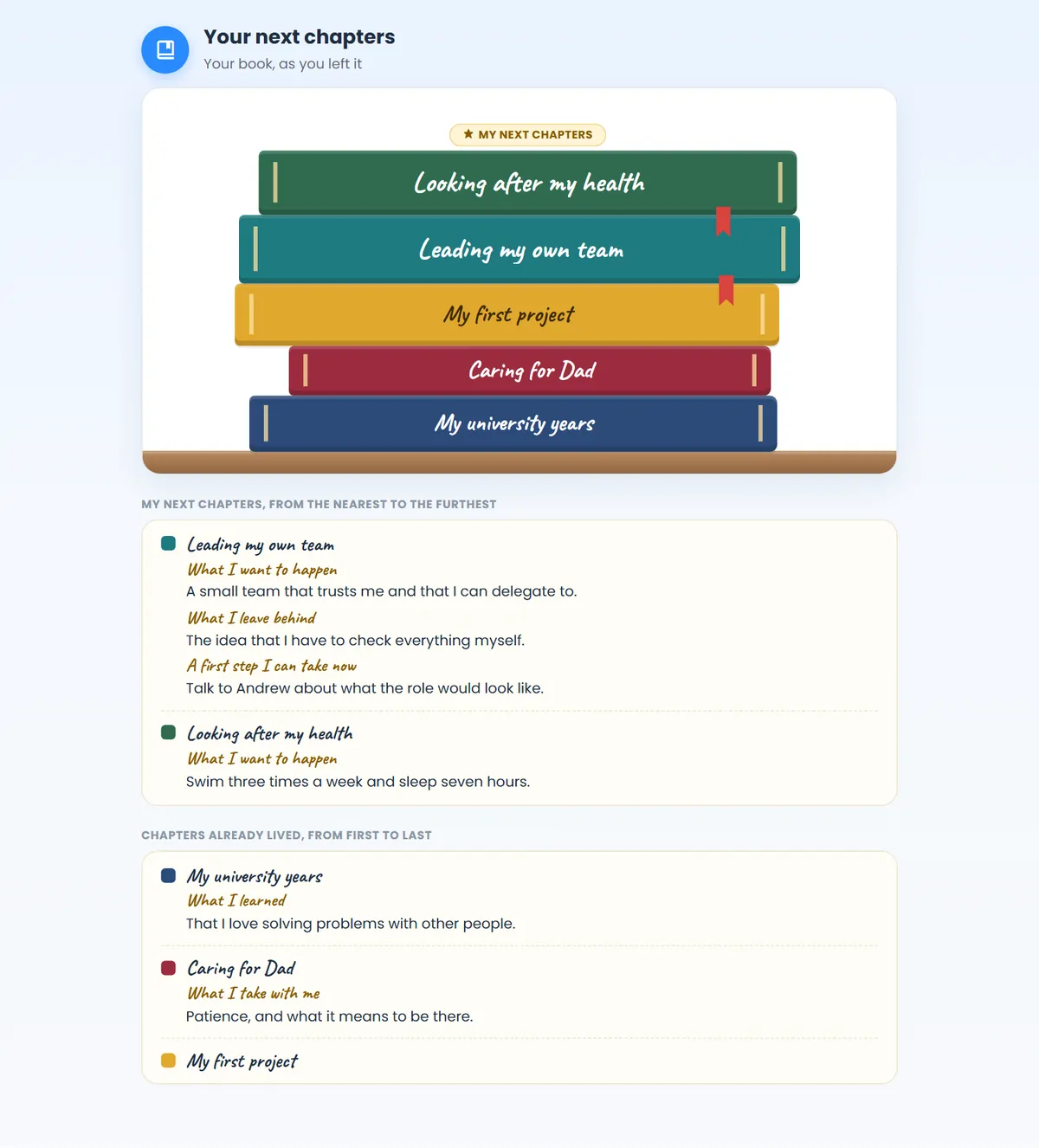
A pile of books: on top, the next chapters you want to write; underneath, the ones you have already lived. Each book opens to note what you want to happen, what you leave behind and what your first step is.

  • Setting goals
  • Personal history and life stages
  • Adapting to change
  • Life project
Weather report
Individual

Weather report

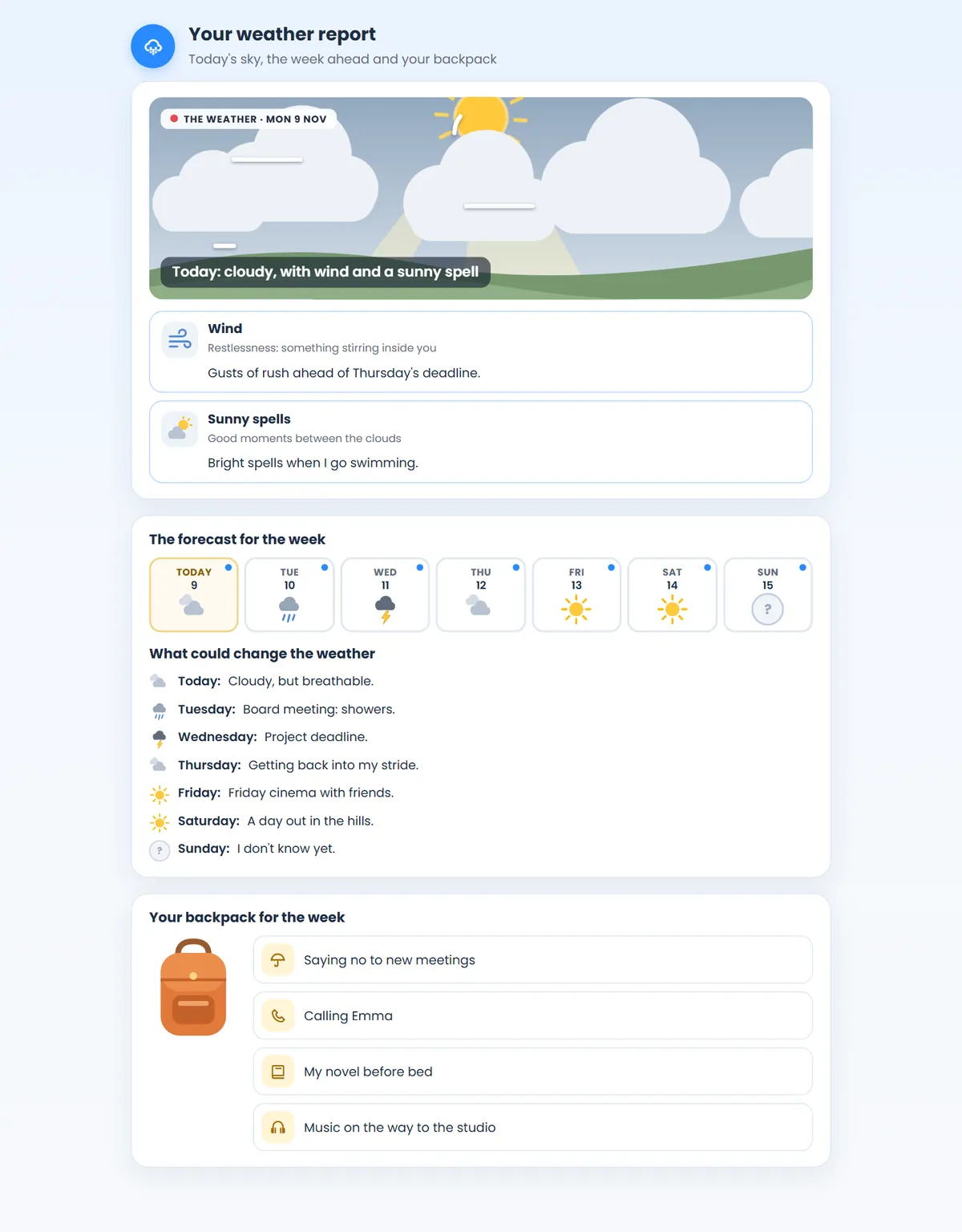
How you feel told as the weather report: today's sky with wind, fog or clear spells, the forecast for the week and a backpack with what can help you.

  • Managing emotions
  • Follow-up
My inner parts
Individual

My inner parts

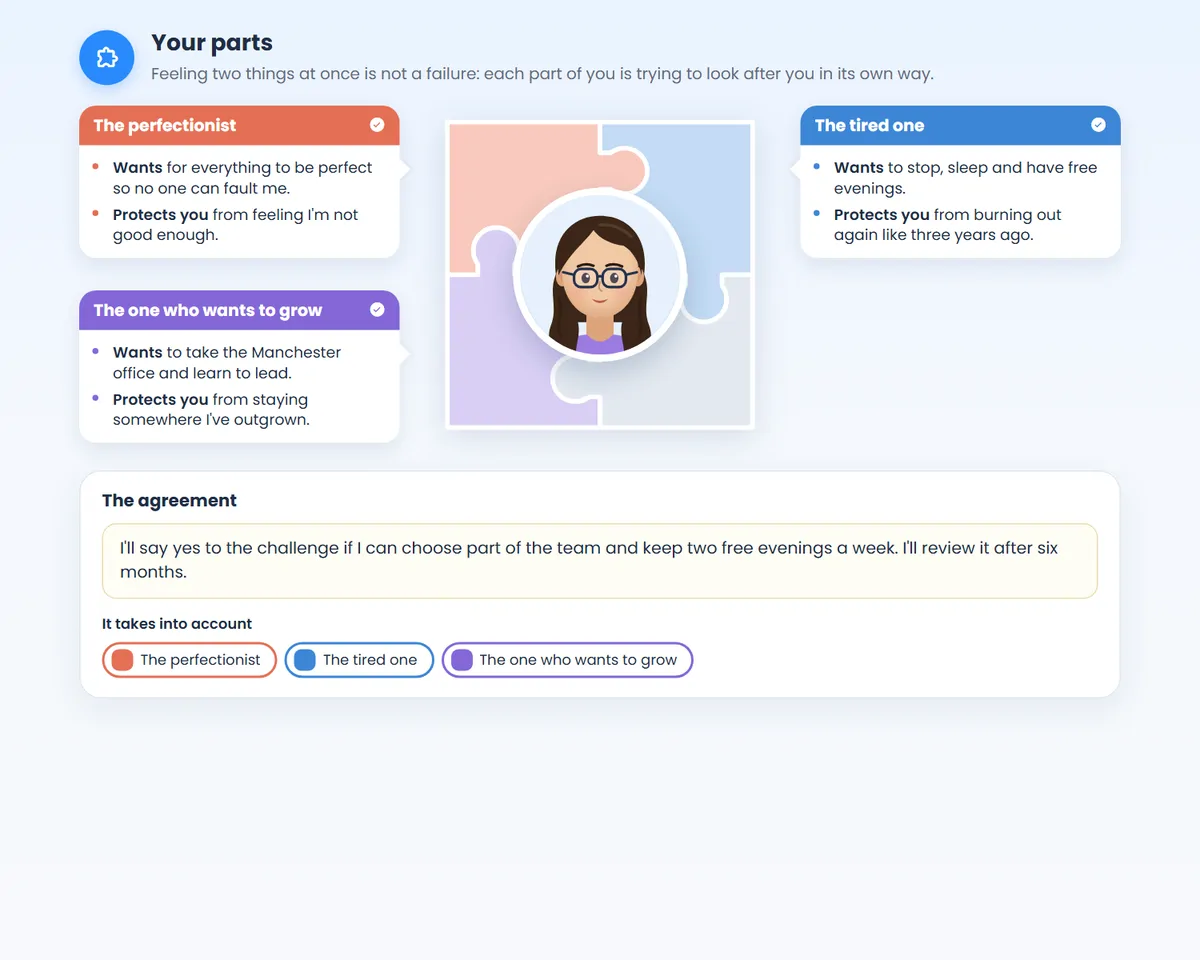
The parts of yourself that pull in opposite directions, with what each one wants and what it protects you from. The puzzle pieces fit together when the final agreement takes all of them into account.

  • Identity and self-knowledge
  • Procrastination and blocks
The miracle question
Individual

The miracle question

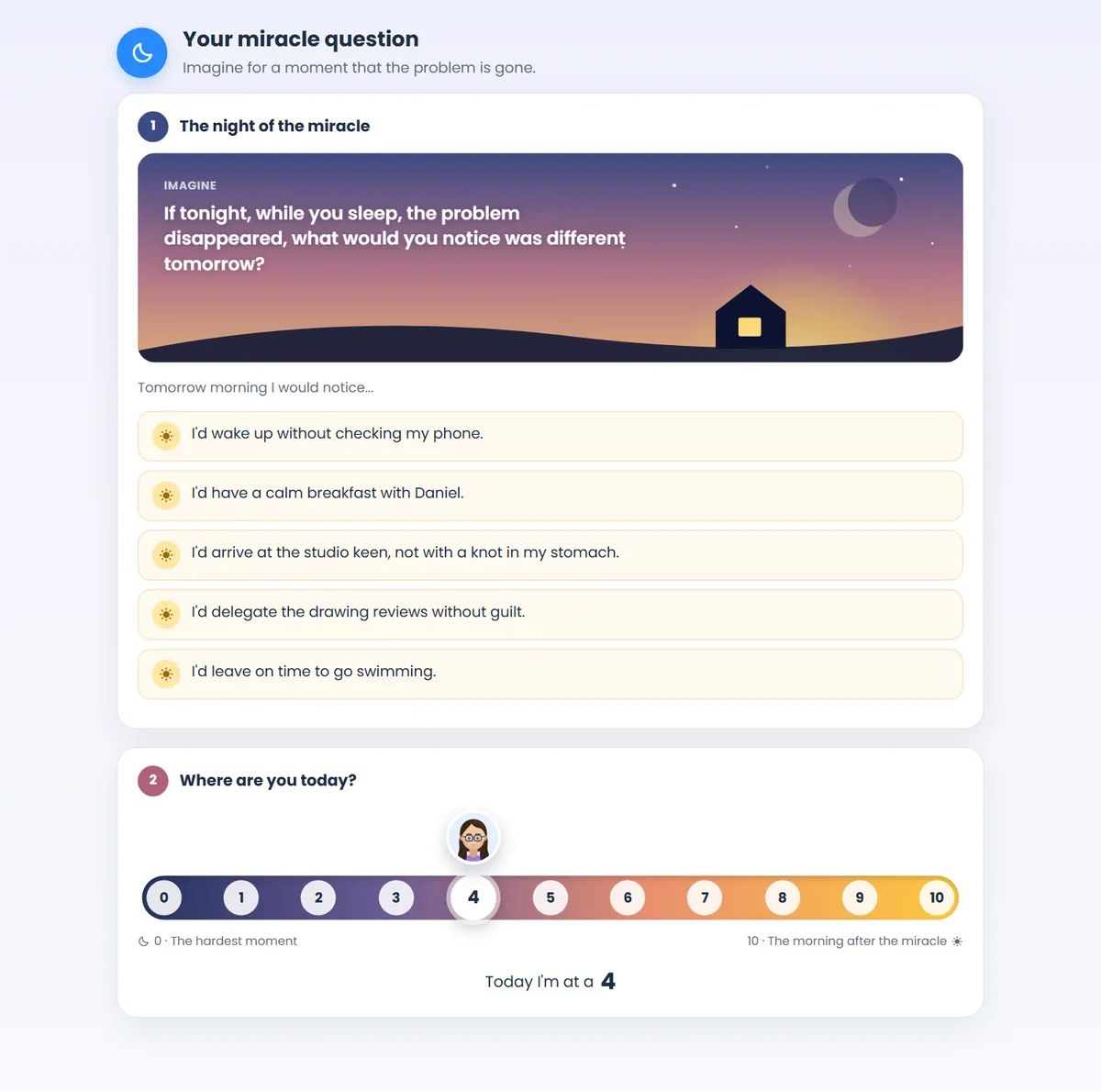
"If tonight, while you slept, the problem disappeared, what would you notice was different tomorrow?" You write down the signs and place yourself today on a scale from 0 to 10.

  • Setting goals
  • Exploring a problem
  • Follow-up
  • Life project
Activity menu
Individual

Activity menu

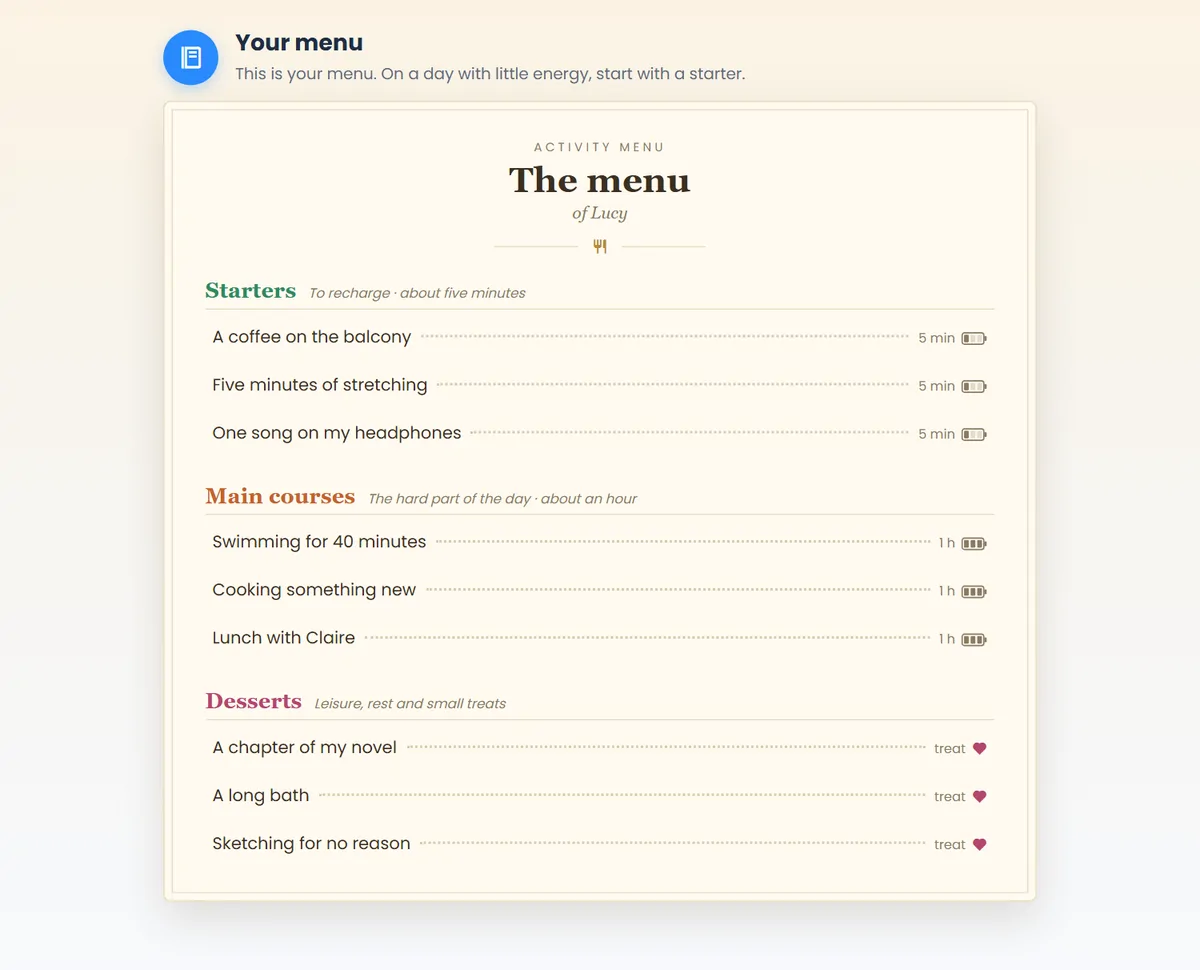
A restaurant menu of your activities: starters that recharge you in five minutes, main courses for the heavy part of the day and desserts to enjoy, each with its energy cost.

  • Motivation and activation
  • Self-care and personal balance
  • Procrastination and blocks
  • Building habits
The stop-doing list
Individual

The stop-doing list

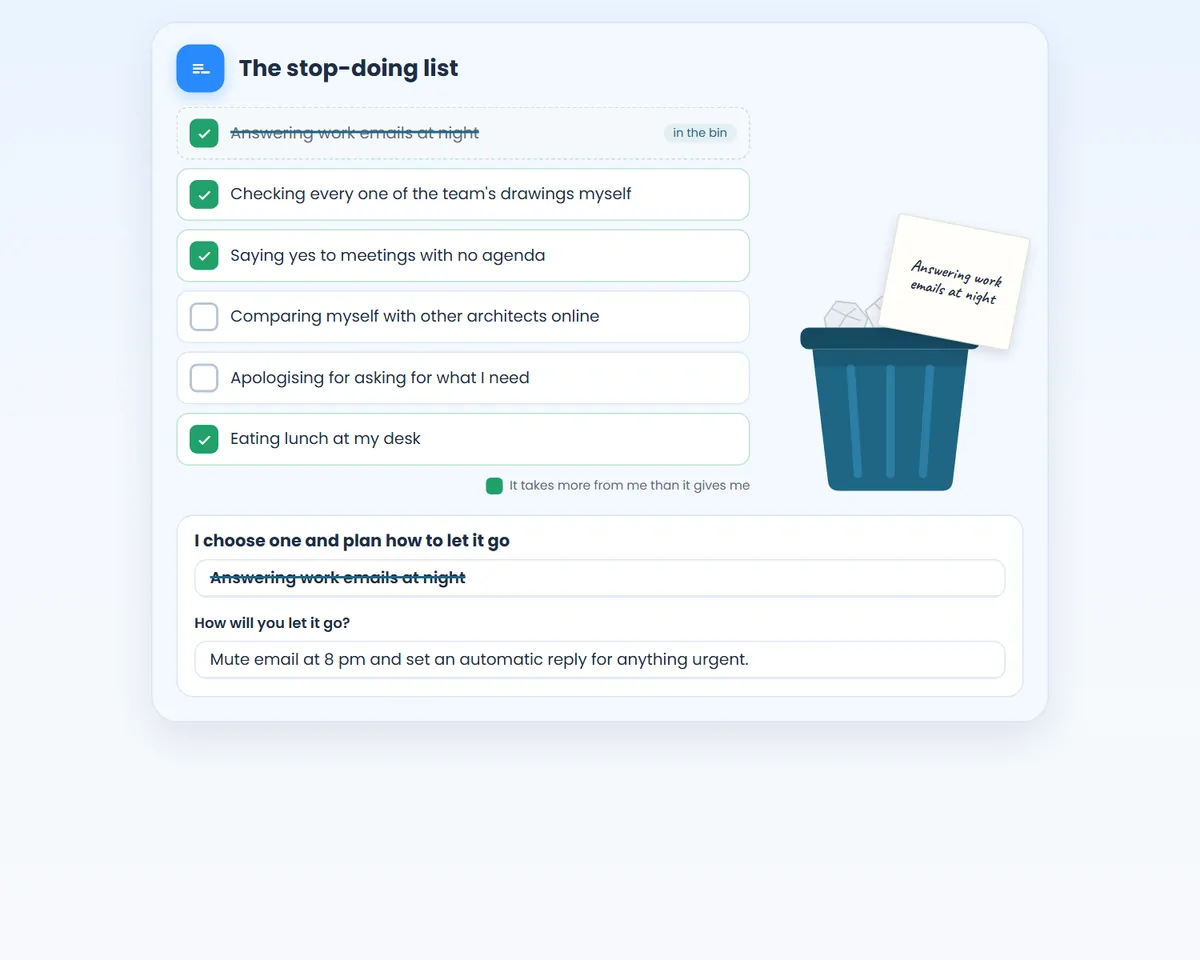
The opposite of a to-do list: what you do out of duty, out of habit or for fear of saying no. You mark what takes more than it gives, choose one thing to throw in the bin and plan how to let it go.

  • Stress and overload
  • Procrastination and blocks
  • Building habits
From "should" to "I'd like"
Individual

From "should" to "I'd like"

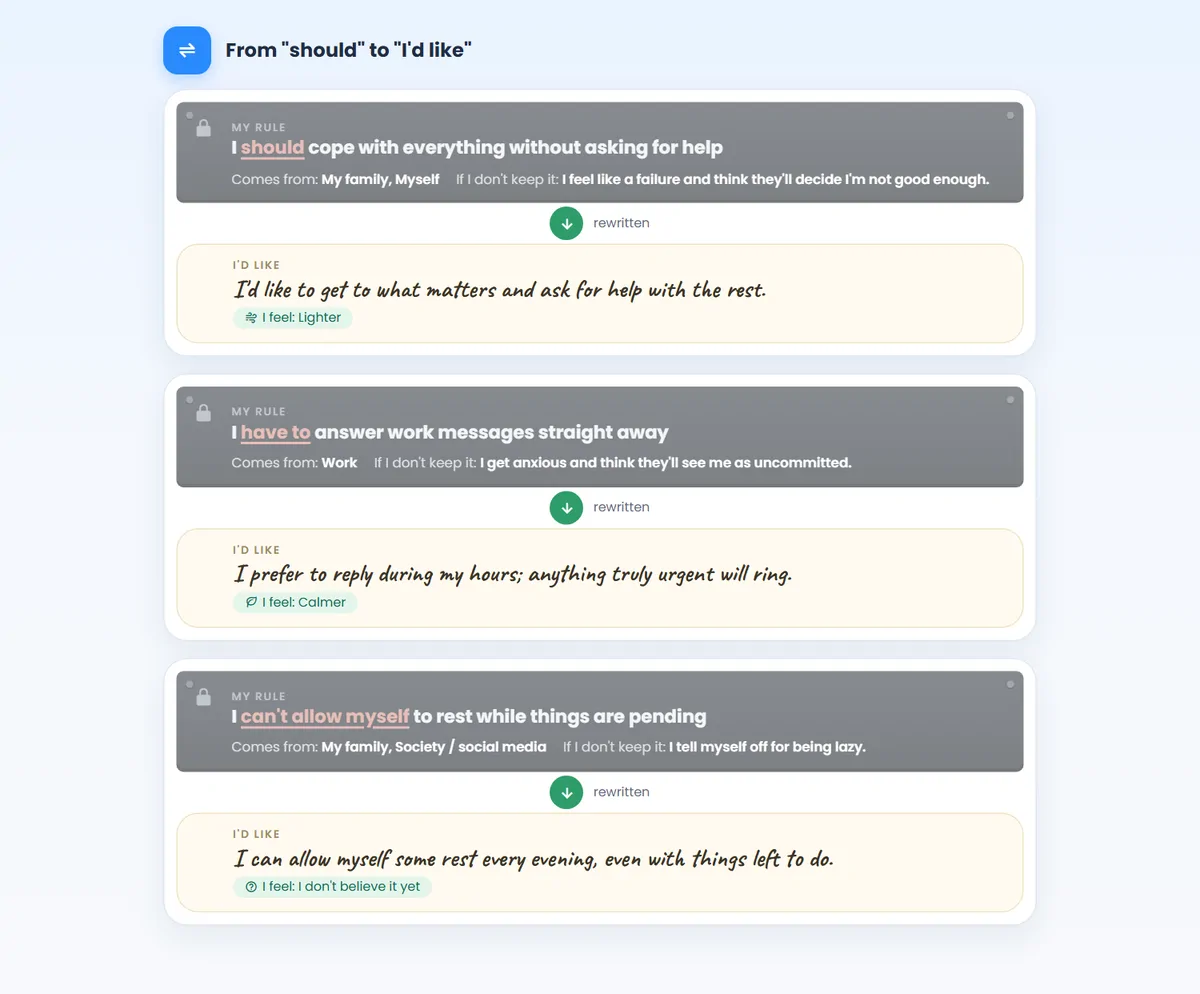
The rigid rules you impose on yourself, with where they come from and what happens when you break them, rewritten as flexible preferences. At the end you rate how the new version feels.

  • Values and priorities
  • Frustration tolerance
Adopt a quote
Individual

Adopt a quote

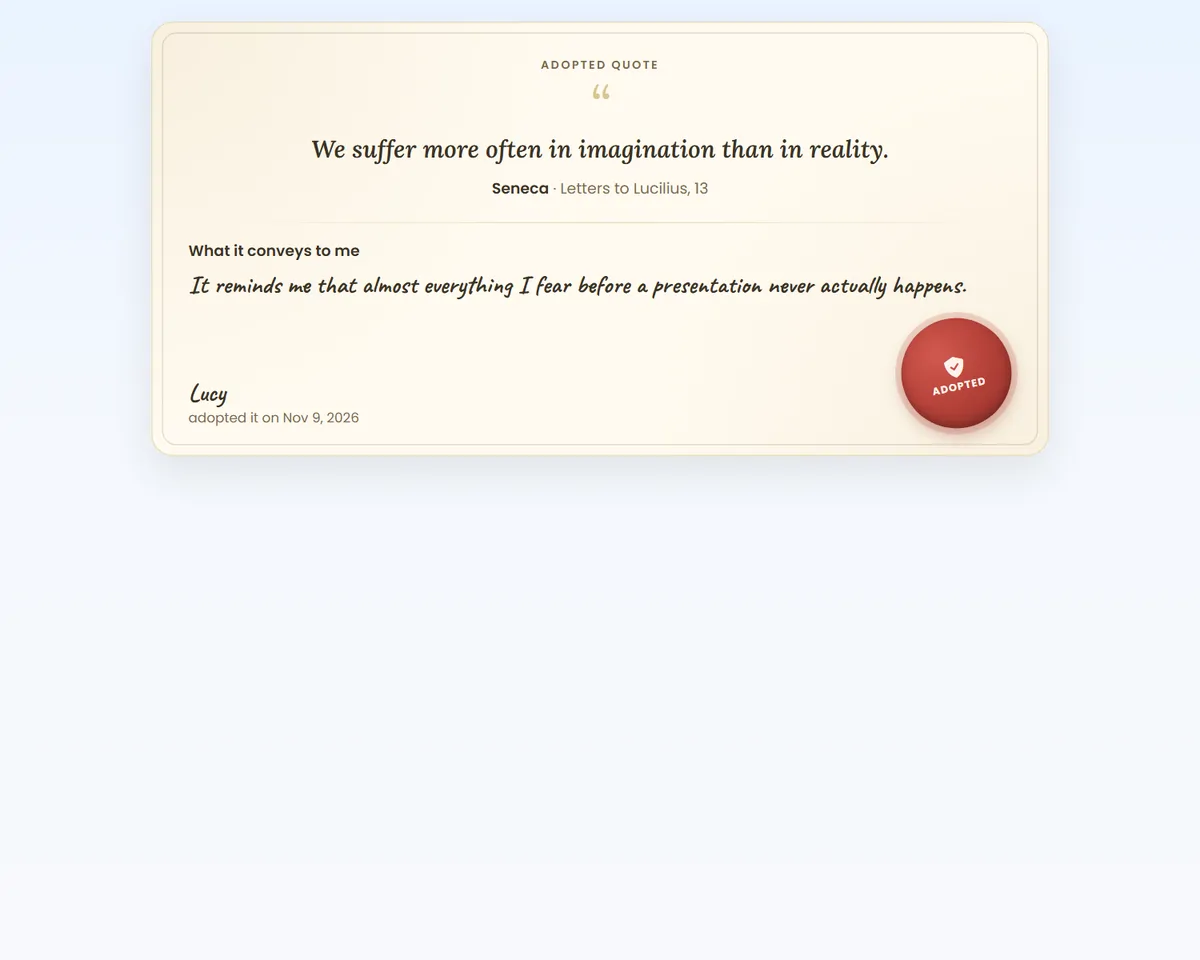
You choose a real quote, with its author and the work it comes from, and write what it says to you. The quote is adopted on a certificate with your name.

  • Motivation and activation
Saying no
Individual

Saying no

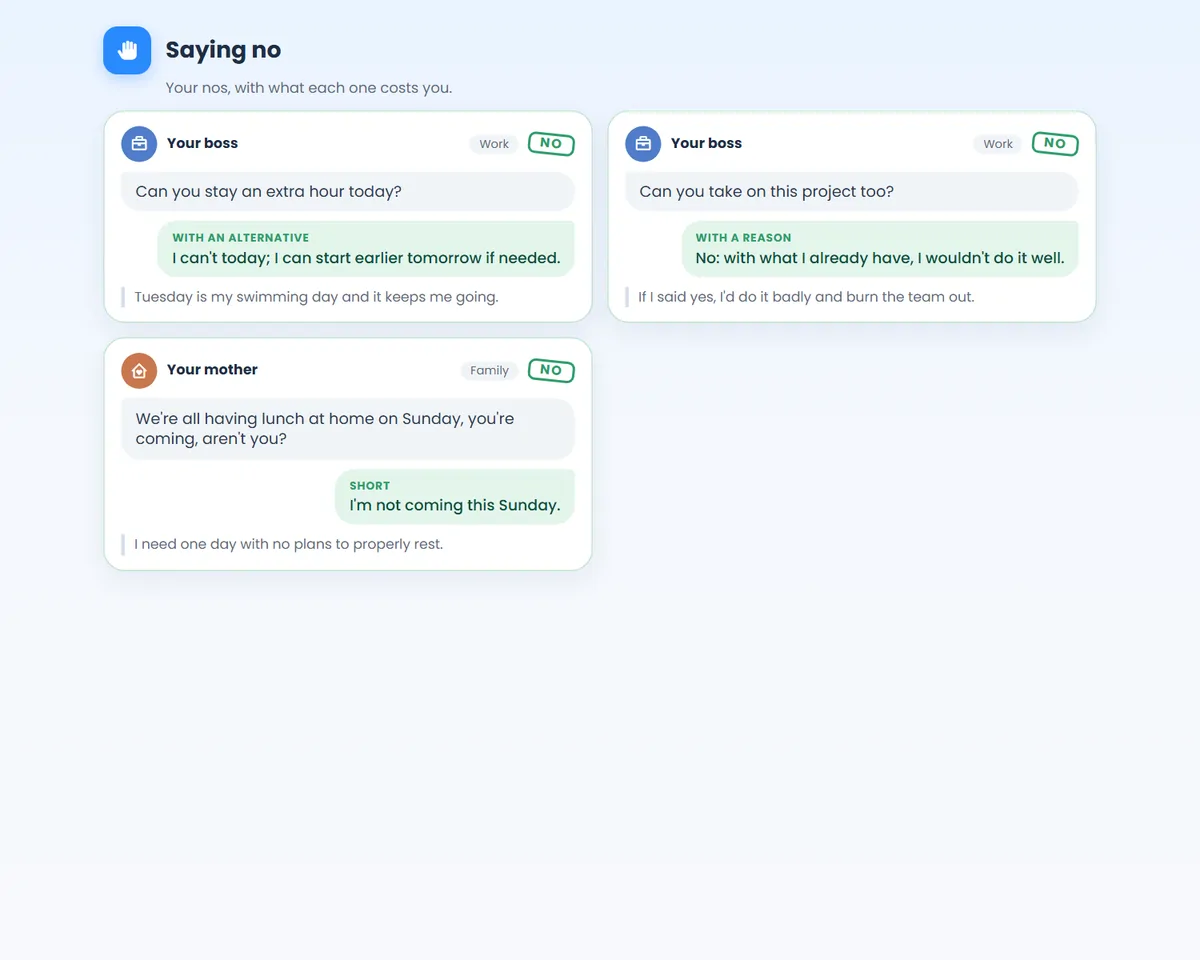
Everyday requests where saying no is hard. For each one you choose a clear, respectful no, already written, and explain a little why.

  • Assertiveness and boundaries
  • Social skills
Decision tree
Individual

Decision tree

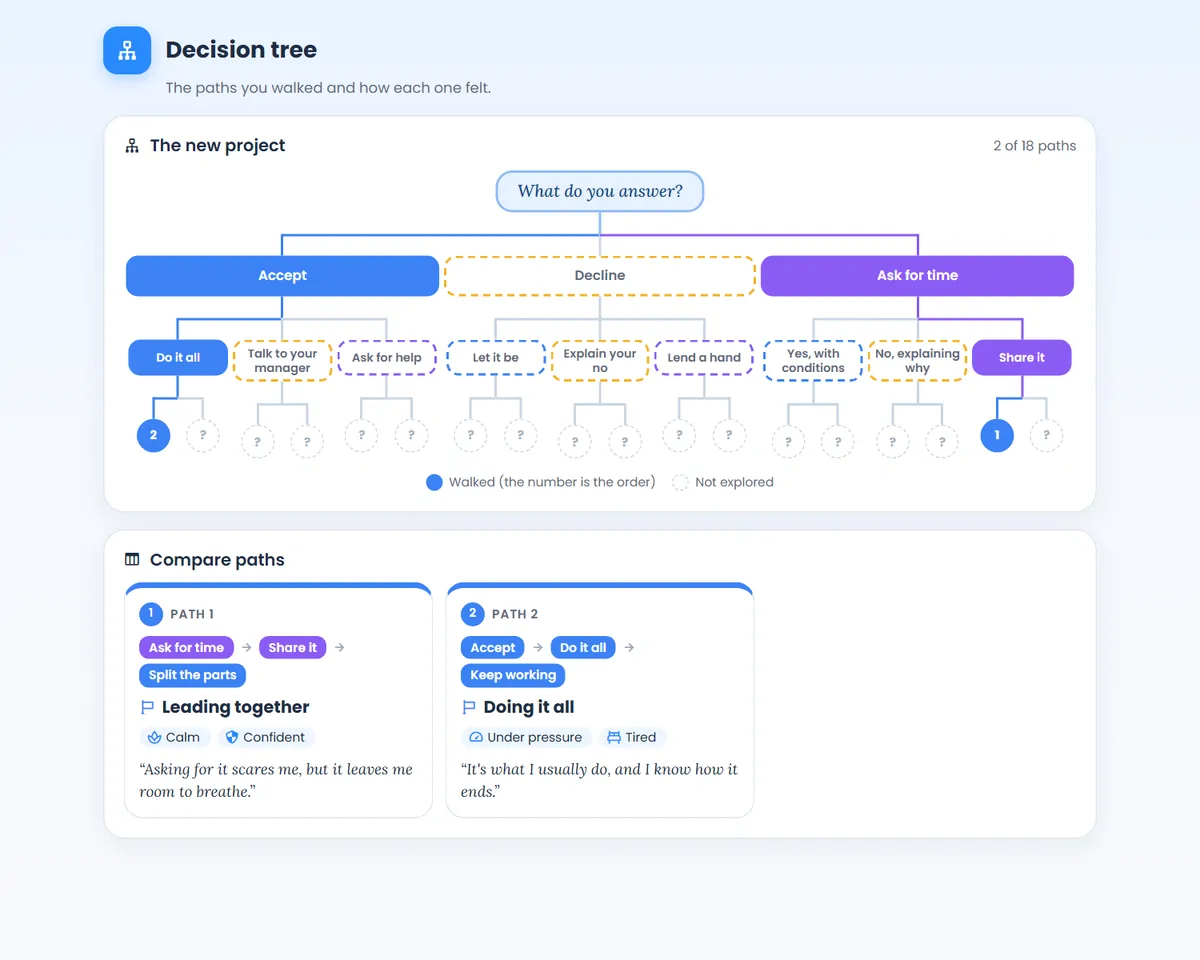
An interactive story in the shape of a flowchart: each answer leads to another scene until an ending with what you gain and what it costs you. You can walk several paths and compare how each one felt.

  • Decision making
  • Interpersonal conflicts
  • Social skills
Ikigai
Individual

Ikigai

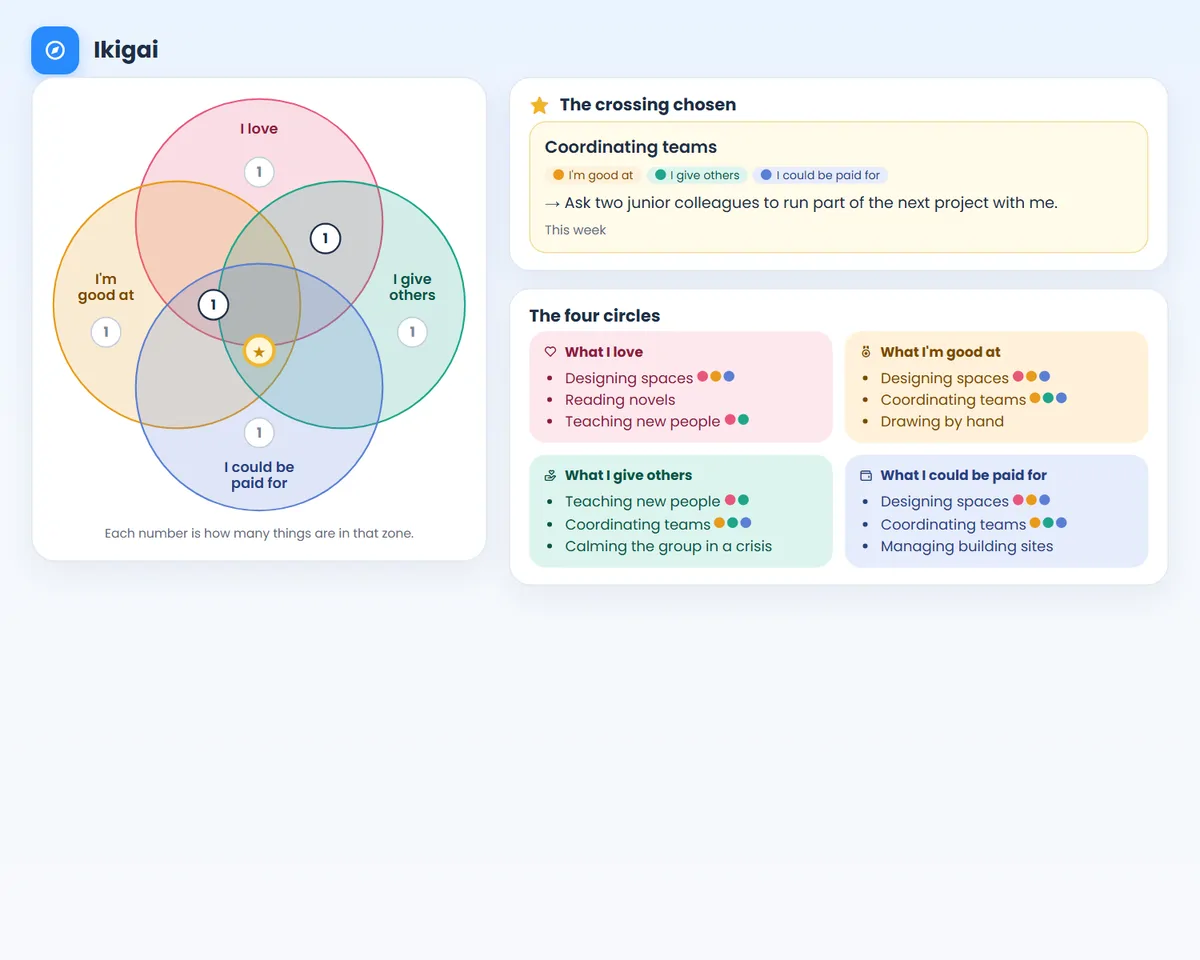
Four circles that cross: what you love, what you are good at, what you give to others and what you could be paid for. You mark what appears in several and choose one crossing with a small step.

  • Identity and self-knowledge
  • Setting goals
  • Values and priorities
  • Life project
Facts and interpretations
Individual

Facts and interpretations

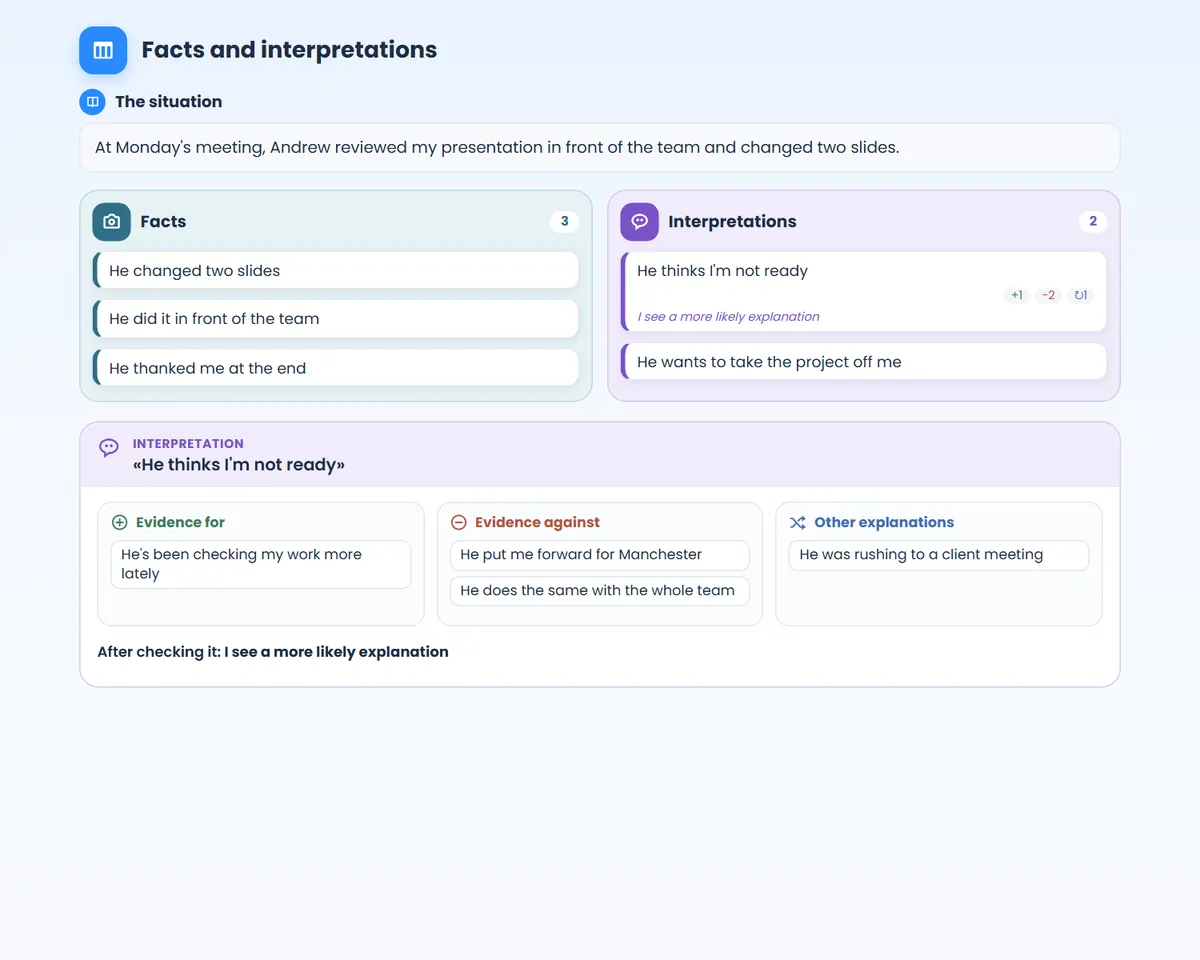
A two-column board that separates what happened, as a camera would see it, from what you deduced. Then you review one interpretation with the evidence for, against and other possible explanations.

  • Exploring a problem
  • Managing emotions
  • Interpersonal conflicts
  • Perspective and empathy

What doing an activity is like

From a link, no account

You open the address you were sent and the activity starts. On a phone, a tablet or a computer.

Your character goes with you

The first time, you build a character that looks like you. It acts out the scenes, keeps your mood and shows up in your results.

Kept, and shared only with whom you choose

What you write is saved with the activity. If a professional sent it to you, they read it in your file; nobody else does.

Want to try an activity?

Create a free account and open any of these dynamics right away.

Start for free